


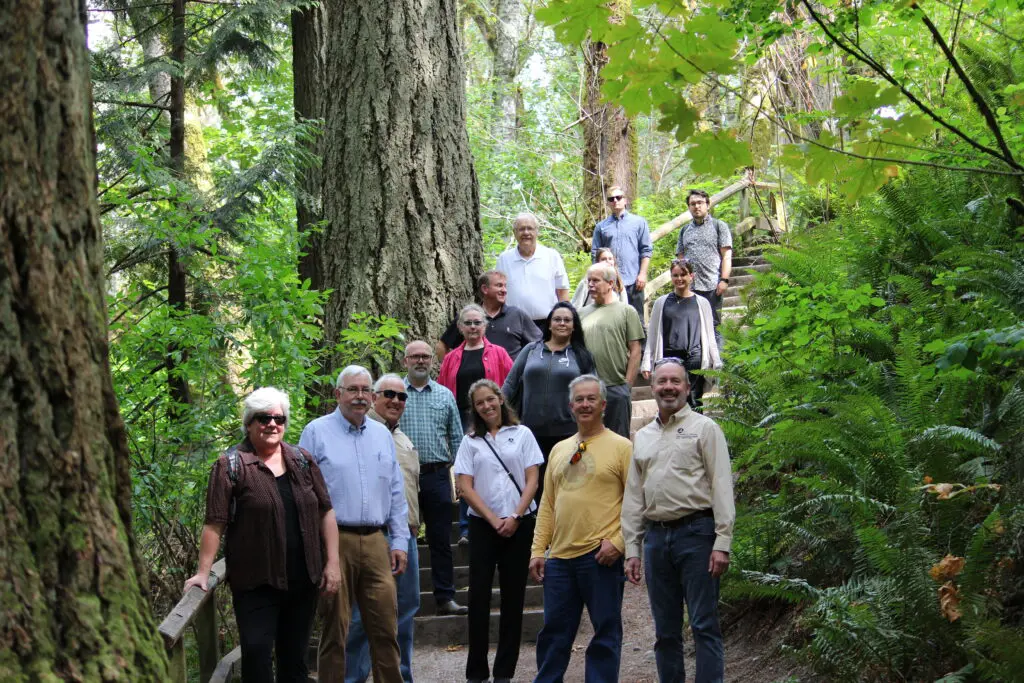
On Wednesday August 10, the Pipeline Safety Trust (PST) hosted Department of Transportation’s Pipeline and Hazardous Materials Safety Administration’s (PHMSA) Accident Investigation Division. The daylong meeting consisted of an interpretative walk of Whatcom Falls Park, the site of the 1999 Bellingham Tragedy.
Special Projects Advisor Carl Weimer gave the tour as accident investigators who ranged from having two months to 20 years of experience learned about the plethora of failures that led to three young boys losing their lives on June 10, 1999.
Carl explained how the 16-inch diameter Olympic Pipeline experienced a rupture that would release 237,000 gallons of gasoline into the creek, which would ultimately ignite. That ignition went on to burn over a mile of creek habitat, killing every living thing within its path.
There was talk from both PST staff and the PHMSA investigators about how this was a “capstone” incident. A significant incident that shed an enormous amount of light on not only lax pipeline safety regulations in place, but also the negligence on behalf of Olympic Pipeline Company.
It meant a lot to PST’s staff and board to host the accident investigation team in Bellingham. Their presence shows they realize how important and serious the Bellingham Tragedy is and find it imperative to make their team understand that nothing of its magnitude should ever be repeated.
Following the tour of Whatcom Creek, we engaged in a productive discussion about PHMSA’s procedures around investigations, Incident Command structure, and current incidents around the country. PHMSA answered PST questions about investigations and shared compelling lessons learned from their years of experience.
It was a productive conversation and stood as a reminder that PST and PHMSA really do view each other as partners. After all, the Pipeline Safety Trust and PHMSA share a goal of zero pipeline-related incidents. But to get there, both of us have a lot of work to do.
Leave a Reply